

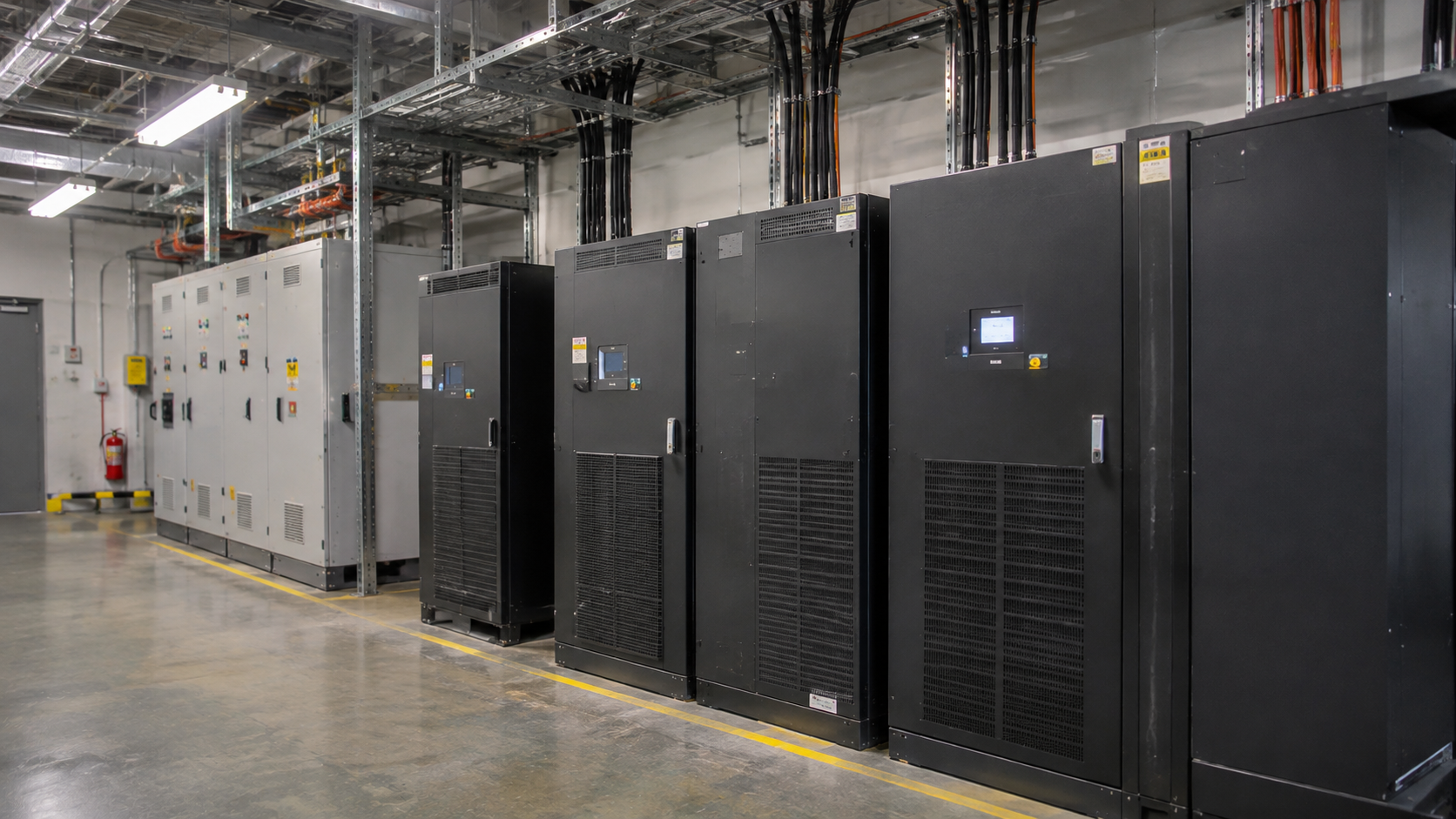
N+1 redundancy means a data centre has the equipment capacity needed to carry its load, plus one spare unit. This can help the affected system withstand a single component failure when the remaining units and distribution paths continue operating. N+1 may be sufficient for many production workloads, but it does not remove every potential point of failure.
This guide is for technical buyers assessing a colocation provider's resilience, whether in Swindon or elsewhere. It compares N+1 with 2N, explains their different infrastructure requirements, and lists the questions that reveal how a design behaves during a failure.
Key takeaways
- N is the capacity your load needs. N+1 adds one spare unit, 2N duplicates the whole system, and 2N+1 duplicates it and adds a spare.
- N+1 survives one component failure, but a shared switchboard, pipe or transfer switch can still be a single point of failure.
- 2N gives you two independent systems, at the cost of about twice the installed plant your load needs.
- Redundancy levels and Uptime Institute Tiers measure different things, so check the distribution paths and testing records as well as the label.
What N+1 redundancy means in a data centre
N+1 redundancy is a design in which a system has the number of components its load requires (N), plus one more. If any one component fails or is taken out for service, the remaining units carry the full load. TechTarget's guide to data centre redundancy defines N as the minimum infrastructure needed to run at full capacity.
The extra unit may share the load all the time or wait in standby. Either way, the "+1" covers one failure at a time: while one unit is down, the system is running at N, with nothing spare until the repair is finished.
Data centre redundancy levels compared
Data centre redundancy levels describe how much spare capacity sits behind the load, from none at all (N) to two full systems plus a spare (2N+1). The table uses an illustrative 400kW IT load fed by 200kW UPS modules. These numbers only show the arithmetic and ignore the sizing margin a real design would add.
| Level | What it means | UPS modules | Installed capacity | What it survives |
|---|---|---|---|---|
| N | Exactly what the load needs | 2 | 400kW | Nothing: any failure drops the load |
| N+1 | One spare unit | 3 | 600kW | One module failing |
| 2N | Two complete systems | 4 | 800kW | One whole system failing |
| 2N+1 | Two complete systems plus a spare | 5 | 1,000kW | One whole system failure; additional module protection depends on configuration |
What is 2N redundancy?
2N redundancy means two complete, independent systems, each able to carry the entire load alone. In normal operation, each side carries about half the load. If one side is lost or shut down for maintenance, the other takes everything.
What is 2N+1 redundancy?
2N+1 redundancy provides two complete systems plus one additional spare component. Whether that spare remains available during a full system failure depends on how the infrastructure is configured. By comparison, 2(N+1) provides a spare within each independent system, which would require six modules in the example above.
What is the difference between N+1 and 2N redundancy?
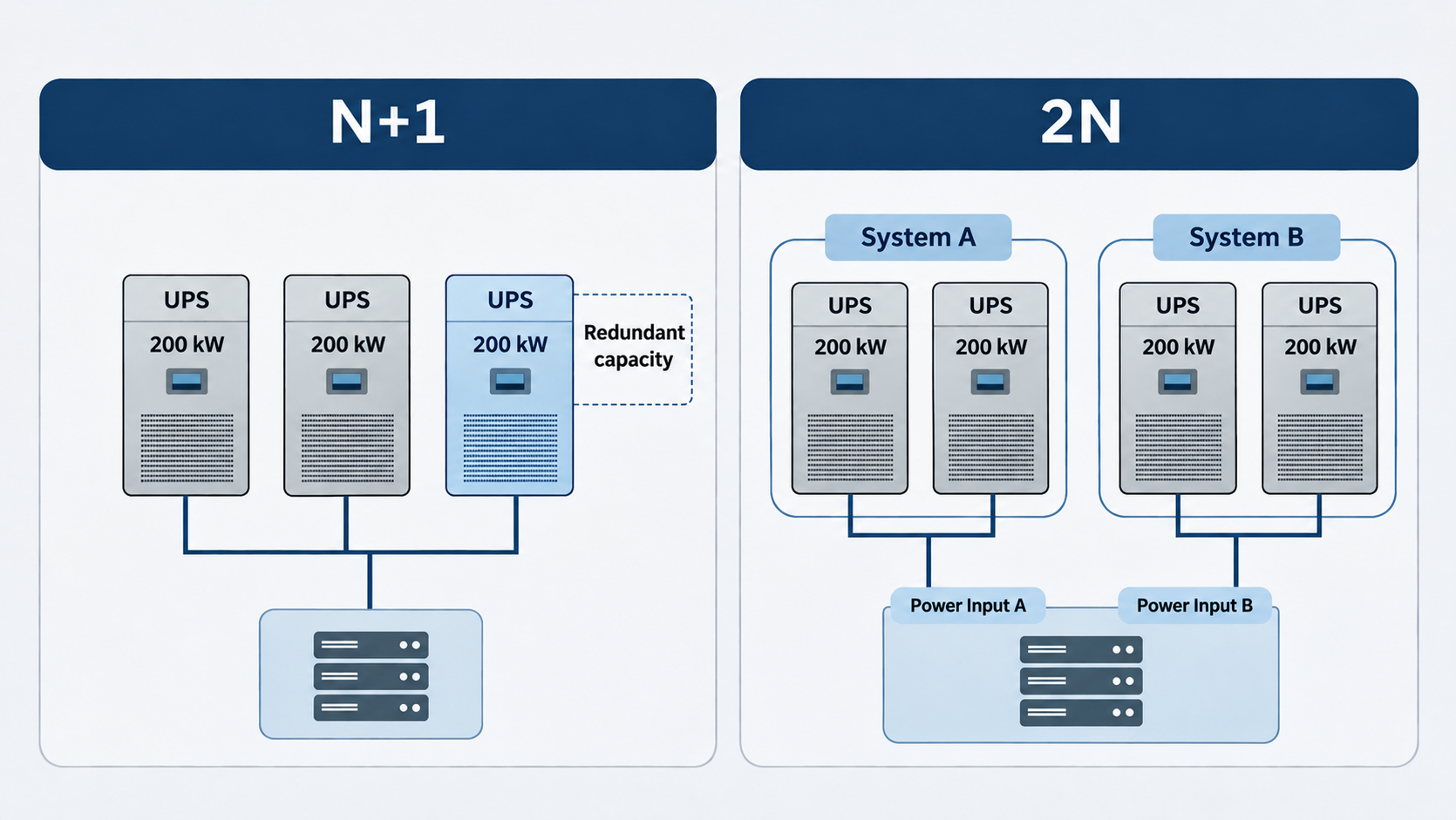
The difference between N+1 and 2N redundancy is what gets duplicated. N+1 duplicates a component, usually within one shared system. 2N duplicates the whole system, including its distribution path, so a failure in one path does not reach the other.
| Question | N+1 | 2N |
|---|---|---|
| Extra plant compared with the load | One unit | A full second system |
| One component fails | Load stays up | Load stays up |
| Shared switchboard or path fails | Load can drop if the path is shared | Other side carries the load |
| Spare during maintenance | None until the unit returns | Other side still carries the load |
| Relative cost | Lower | Higher |
The practical question in any N+1 vs 2N comparison is which failures your workload can tolerate, and which your application already handles in software.
Which systems in a data centre need redundancy?
Every system your servers depend on continuously needs redundancy, and a design is only as strong as its weakest one. A level quoted for UPS tells you nothing about cooling, so ask about each system separately.
UPS
UPS systems keep the load running through a mains failure until generators take over, and N+1 here usually means one more module than the load requires. Uptime Institute's Annual Outage Analysis 2026 reports that power issues caused 45% of respondents' most recent impactful outages in 2025 (sample of 96), and that 92% of respondents in a separate survey (sample of 220) saw human error as at least a minor contributor. The same report names UPS failures as the most frequently cited power cause, followed by transfer switch and generator issues.
Generators
Generators carry the site through a longer mains outage, so N+1 means enough sets to run the load with one failed to start. Fuel supply and the transfer switches that move the load onto generator power are part of the same chain, and load testing is what proves that chain works.
Cooling redundancy
Cooling redundancy means the room or the rack stays within temperature when a cooling unit, pump or heat rejection unit fails. Unit count alone can mislead, because the failed unit's location affects airflow. Liquid-cooled racks add their own items to check, including pumps, pipework and each coolant distribution unit, so ask whether your density has been modelled with one unit out.
A+B power feeds

A+B power feeds are two separate power supplies to the rack, and a dual-corded server draws from both so it can lose one without stopping. The protection only exists if the equipment is wired correctly. A Uptime Institute Journal article on dual-corded power cites anecdotal evidence that 1% to 10% of servers in a data centre may be improperly corded, and it recommends rack-level transfer switches for single-corded kit. Audit your own cabling when you move in.
Connectivity
Network paths need the same treatment, since two power systems will not help if a single fibre route fails. See our guide to network resilience.
Where N+1 still leaves a single point of failure
N+1 can still leave a single point of failure, because spare units often connect through shared switchboards, busbars or pipework. A single point of failure is any one item whose loss stops the load.
Concurrent maintainability is the related test. A concurrently maintainable site can take any component out for planned work without shutting down the IT load. Uptime Institute's Tier myths article says Tier II allows concurrent maintenance of capacity components but not distribution pathways or critical elements, while Tier III also requires active/active distribution for critical power. The same article says that adding components does not by itself determine a Tier, and that a Tier IV design with only N+1 components is possible, depending on its configuration and distribution paths.
So "N+1" and "Tier III" are separate statements: one counts units, the other describes how the site behaves during maintenance or failure. The article also states that Uptime Institute is the only organisation permitted to certify against its Tiers, so ask to see the certificate behind any Tier claim.
Is N+1 enough for a production workload?
N+1 is enough for a production workload when one facility failure would be survivable, either because the application can fail over or because a short outage is acceptable. It is often the wrong fit when one site must stay up through a path failure, with no fallback elsewhere.
- N+1 usually suits: stateless or clustered applications, workloads replicated to a second site, AI training jobs that can restart from a checkpoint, and development or test estates.
- 2N is worth pricing for: single-site systems of record, equipment that cannot be paused, and contracts with strict availability penalties.
- Two sites can provide additional protection: geographically separated facilities may reduce exposure to local incidents such as fire, flooding or network failures, provided failover arrangements are properly designed and tested. Our guide to where to colocate in the UK explains why geographic separation matters for resilient infrastructure.
Regulated firms should start from the business service. The Prudential Regulation Authority's SS1/21 requires UK banks, building societies and insurers to stay within impact tolerances for important business services, with a deadline of 31 March 2025, whether or not they use third parties. Any financial services colocation design has to support those tolerances, because the firm stays responsible when a provider fails.
Hypothetical example: a software company asks whether N+1 is enough for its customer platform. It runs in one hall, with a database cluster replicated to a second site and a recovery time it has already tested. A failed switchboard triggers a rehearsed failover, so N+1 is a reasonable answer. Remove the second site and the same question points towards 2N.
Redundancy also has limits. Uptime Institute's 2026 report says future improvements will likely depend less on incremental gains in redundancy, and describes regular testing, staff training and disciplined change management as among the most effective ways to reduce outage risk.
How does redundancy affect colocation price?
Redundancy raises colocation price because the operator buys, houses and maintains plant that your load does not use day to day. In the 400kW example above, N+1 needs 1.5 times the load in installed UPS capacity, 2N needs twice, and 2N+1 needs 2.5 times.
Compare the level of resilience each quote includes and whether power charges are based on contracted capacity, measured consumption or both. We offer power-based commercial terms for high-density colocation, while standard deployments may be priced by rack or unit. A power assessment can help buyers understand their power requirements before comparing colocation options.
Questions to ask a colocation provider about redundancy
Seven questions separate a design from a label:
- Which redundancy level applies to UPS, generators and cooling, stated separately?
- Which paths are shared between the redundant units, and what happens if one fails?
- Can each component be maintained without shutting down the IT load?
- Are A+B power feeds independent back to the UPS, and who checks server cabling?
- How often is generator and UPS load testing done, and can I see the records?
- Has any Tier claim been certified, for the design or for the constructed facility?
- Does the stated redundancy hold at my rack density, with one cooling unit out?
Our certifications page outlines the available documentation, including power and cooling topology diagrams and resilience testing records. Buyers should request equivalent evidence from every shortlisted provider.
Frequently asked questions
What does the N stand for in N+1?
N stands for the need: the number of components required to carry the full load, with no spare. If a site needs three cooling units to hold temperature, N is three, and N+1 means four. N grows with the load, so an N+1 design can lose its spare as capacity is used up.
What is the difference between N+1 and N+2?
N+2 redundancy adds two spare components rather than one. The second spare matters during maintenance, because the site can have one unit out for service and still survive a failure in another.
Does N+1 redundancy mean no downtime?
N+1 redundancy does not guarantee zero downtime. It is designed to tolerate a single failure of a redundant capacity component, provided the remaining system can support the load. A shared distribution path, a second failure during repair or human error can still interrupt service.
What does N-1 mean in redundancy?
N-1 describes the same idea from the other direction: the system must keep working with one component lost. The term is also used in electricity network planning, and buyers often hear it alongside N+1.
Choosing the right level for your servers
N+1 redundancy gives you one spare unit behind the load, which suits many production workloads when the application or a second site covers path failures. Choose 2N when one site must keep running through the loss of a whole system.
Our air-cooled environments are built to N+1 redundancy across power and cooling, with dual power feeds and UPS systems standard across hosted rack positions and standby generation with regular load testing.
To talk through what your workload needs, speak to an engineer about colocation in Swindon, where our facility sits on the M4 corridor. Tell us your rack density, and we will size the right cooling platform.



%20--%3e%3csvg%20version='1.1'%20id='Layer_1'%20xmlns='http://www.w3.org/2000/svg'%20xmlns:xlink='http://www.w3.org/1999/xlink'%20x='0px'%20y='0px'%20viewBox='0%200%20388.2%20150.6'%20style='enable-background:new%200%200%20388.2%20150.6;'%20xml:space='preserve'%3e%3cstyle%20type='text/css'%3e%20.st0{fill:%2304C7FD;}%20.st1{fill:%230068B5;}%20%3c/style%3e%3crect%20y='2.1'%20class='st0'%20width='28.1'%20height='28.1'/%3e%3cpath%20class='st1'%20d='M27.4,148.5V47.3H0.8v101.2H27.4z%20M204.2,149.5v-24.8c-3.9,0-7.2-0.2-9.6-0.6c-2.8-0.4-4.9-1.4-6.3-2.8%20c-1.4-1.4-2.3-3.4-2.8-6c-0.4-2.5-0.6-5.8-0.6-9.8V70.1h19.3V47.3h-19.3V7.8h-26.7v97.9c0,8.3,0.7,15.3,2.1,20.9%20c1.4,5.5,3.8,10,7.1,13.4s7.7,5.8,13,7.3c5.4,1.5,12.2,2.2,20.3,2.2L204.2,149.5L204.2,149.5z%20M357,148.5V0h-26.7v148.5H357z%20M132.5,57.2c-7.4-8-17.8-12-31-12c-6.4,0-12.2,1.3-17.5,3.9c-5.2,2.6-9.7,6.2-13.2,10.8l-1.5,1.9v-1.7V47.3H43v101.2h26.5V94.6v3.7%20c0-0.6,0-1.2,0-1.8c0.3-9.5,2.6-16.5,7-21c4.7-4.8,10.4-7.2,16.9-7.2c7.7,0,13.6,2.4,17.5,7c3.8,4.6,5.8,11.1,5.8,19.4l0,0v0.2l0,0%20l0,0v53.5h26.9V91C143.7,76.6,139.9,65.2,132.5,57.2z%20M316.5,97.7c0-7.3-1.3-14.1-3.8-20.5c-2.6-6.3-6.2-11.9-10.7-16.7%20c-4.6-4.8-10.1-8.5-16.5-11.2s-13.5-4-21.2-4c-7.3,0-14.2,1.4-20.6,4.1c-6.4,2.8-12,6.5-16.7,11.2s-8.5,10.3-11.2,16.7%20c-2.8,6.4-4.1,13.3-4.1,20.6c0,7.3,1.3,14.2,3.9,20.6c2.6,6.4,6.3,12,10.9,16.7c4.6,4.7,10.3,8.5,16.9,11.2%20c6.6,2.8,13.9,4.2,21.7,4.2c22.6,0,36.6-10.3,45-19.9l-19.2-14.6c-4,4.8-13.6,11.3-25.6,11.3c-7.5,0-13.7-1.7-18.4-5.2%20c-4.7-3.4-7.9-8.2-9.6-14.1l-0.3-0.9h79.5L316.5,97.7L316.5,97.7z%20M237.2,88.4c0-7.4,8.5-20.3,26.8-20.4c18.3,0,26.9,12.9,26.9,20.3%20L237.2,88.4z'/%3e%3cpath%20class='st1'%20d='M387.4,135.3c-0.5-1.2-1.2-2.2-2.1-3.1c-0.9-0.9-1.9-1.6-3.1-2.1s-2.5-0.8-3.8-0.8c-1.4,0-2.6,0.3-3.8,0.8%20c-1.2,0.5-2.2,1.2-3.1,2.1c-0.9,0.9-1.6,1.9-2.1,3.1c-0.5,1.2-0.8,2.5-0.8,3.8c0,1.4,0.3,2.6,0.8,3.8s1.2,2.2,2.1,3.1%20c0.9,0.9,1.9,1.6,3.1,2.1s2.5,0.8,3.8,0.8c1.4,0,2.6-0.3,3.8-0.8c1.2-0.5,2.2-1.2,3.1-2.1c0.9-0.9,1.6-1.9,2.1-3.1%20c0.5-1.2,0.8-2.5,0.8-3.8S387.9,136.5,387.4,135.3z%20M385.8,142.3c-0.4,1-1,1.9-1.7,2.6c-0.7,0.7-1.6,1.3-2.6,1.7s-2,0.6-3.2,0.6%20c-1.1,0-2.2-0.2-3.2-0.6c-1-0.4-1.9-1-2.6-1.7s-1.3-1.6-1.7-2.6c-0.4-1-0.6-2-0.6-3.2c0-1.1,0.2-2.2,0.6-3.2s1-1.9,1.7-2.6%20c0.7-0.7,1.6-1.3,2.6-1.7s2-0.6,3.2-0.6c1.1,0,2.2,0.2,3.2,0.6c1,0.4,1.9,1,2.6,1.7s1.3,1.6,1.7,2.6c0.4,1,0.6,2,0.6,3.2%20C386.5,140.3,386.2,141.3,385.8,142.3z%20M380.2,139.9c0.8-0.1,1.4-0.4,1.9-0.9s0.8-1.2,0.8-2.2c0-1.1-0.3-1.9-1-2.5%20c-0.6-0.6-1.7-0.9-3-0.9h-4.4v11.3h2.1v-4.6h1.5l2.8,4.6h2.2L380.2,139.9z%20M379.1,138.3c-0.3,0-0.6,0-1,0h-1.5v-3.2h1.5%20c0.3,0,0.6,0,1,0c0.3,0,0.6,0.1,0.9,0.2c0.3,0.1,0.5,0.3,0.6,0.5s0.2,0.5,0.2,0.9s-0.1,0.7-0.2,0.9c-0.2,0.2-0.4,0.4-0.6,0.5%20C379.7,138.2,379.4,138.3,379.1,138.3z'/%3e%3c/svg%3e)