
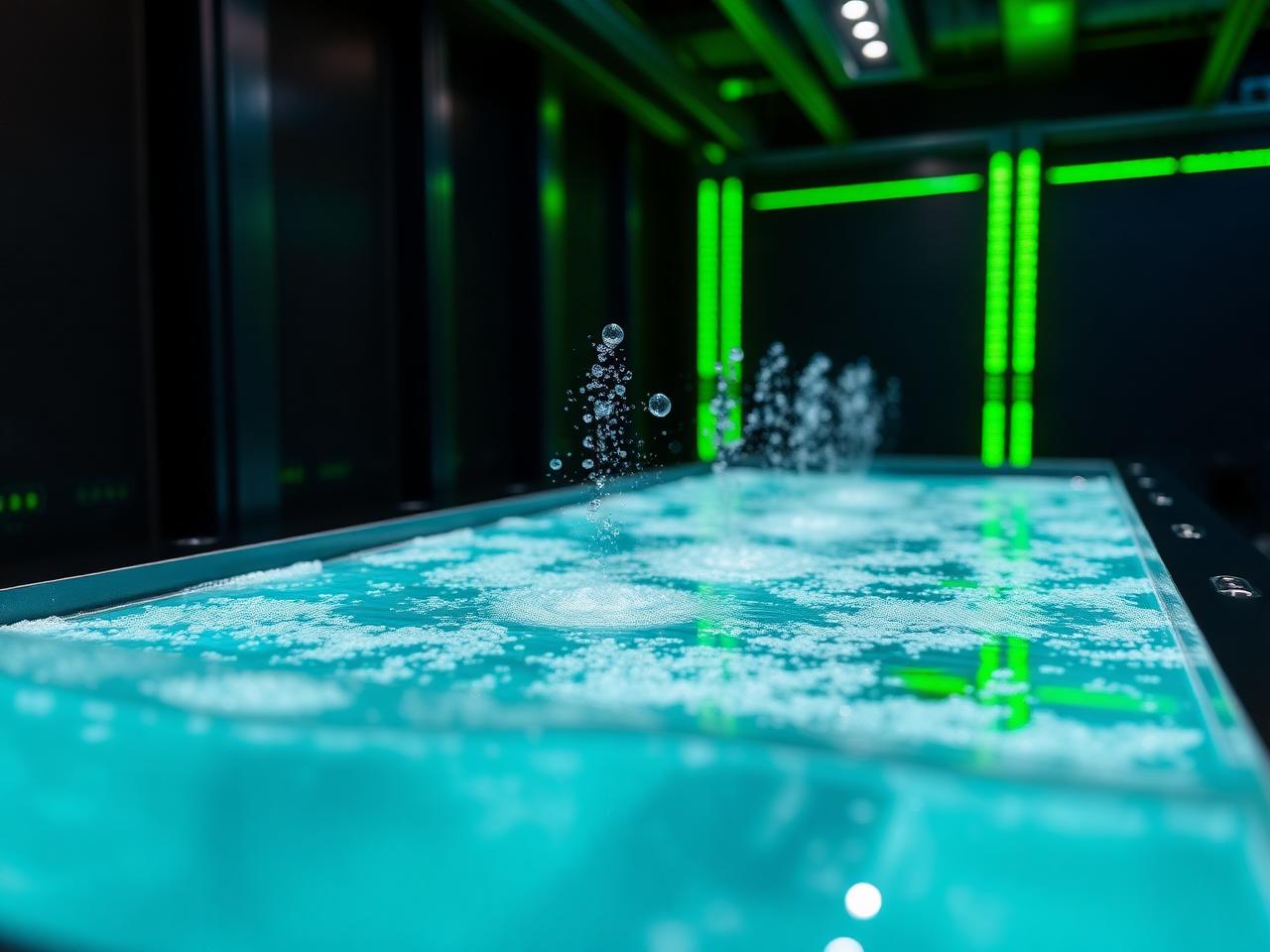
Immersion cooling is a data centre cooling method where servers, GPUs or other IT hardware are submerged in a non-conductive dielectric fluid. Instead of relying on fans and cold air to carry heat away, the liquid absorbs heat directly from the components and moves it through a controlled cooling loop.
That is the short version. The more useful version is this: immersion cooling is designed for infrastructure where traditional airflow starts to struggle.
As computing equipment becomes more powerful, compact and energy-intensive, cooling has become a core design decision. Poor cooling design can limit rack density, increase overhead and reduce hardware performance under sustained load.
At Carbon-Z, we look at immersion cooling as a practical response to one clear problem: high-density infrastructure needs cooling that can keep up.
How immersion cooling works
In a traditional air-cooled environment, server fans move air across hot components. That heat is then removed through airflow management, computer room cooling systems, chilled water systems or other supporting infrastructure.
Immersion cooling changes the thermal path. Compatible hardware is placed inside a tank or engineered enclosure filled with dielectric fluid. This fluid does not conduct electricity, so it can safely come into contact with suitable electronic components. As the hardware runs, heat transfers into the liquid. The warmed fluid then moves through a heat exchanger or cooling loop before returning to the tank.
The process usually works like this:
Compatible IT hardware is prepared for immersion.
The equipment is submerged in dielectric fluid.
Heat transfers from components into the liquid.
The warmed fluid moves through a cooling loop.
Heat is removed through a heat exchanger.
The cooled fluid returns to the tank.
The main advantage is direct contact. Liquid can absorb and transfer heat more effectively than air, so immersion cooling removes heat much closer to the source.
What is dielectric fluid?
Dielectric fluid is a specialist liquid that does not conduct electricity. In immersion cooling, it replaces air as the main cooling medium around the hardware.
A suitable immersion fluid needs to do more than prevent electrical issues. It must support heat transfer, remain stable over time, work with the materials inside the hardware and fit the maintenance model of the system.
Important properties include:
Electrical insulation
Strong heat transfer capability
Chemical stability
Material compatibility with seals, cables, plastics and boards
Suitable viscosity for circulation
Practical maintenance and filtration requirements
This is where the engineering review earns its keep. Immersion cooling is not a case of dropping any server into any liquid and calling it clever. Hardware, fluid, tank design, monitoring and servicing all need to work together.
For technical context, the Open Compute Project design guidelines for immersion-cooled IT equipment outline important considerations around hardware design, integration and compatibility.
Single-phase vs two-phase immersion cooling
There are two main types of immersion cooling: single-phase and two-phase. Both use dielectric fluid, but they manage heat differently.
In a single-phase system, the fluid remains liquid throughout the cooling cycle. It absorbs heat, passes through a heat exchanger and returns to the tank. For many commercial deployments, this is the more practical route because it provides strong thermal performance without the added complexity of managing a phase change.
In a two-phase system, the fluid changes state. It absorbs heat, boils into vapour, then condenses back into liquid. This can remove heat effectively, but fluid selection, containment, vapour management and maintenance all need careful review.
Why immersion cooling is becoming more relevant
The main driver is power density.
Many standard enterprise workloads still run well in air-cooled racks. The challenge begins when more heat is packed into less space. That may come from denser servers, accelerator cards, high-utilisation workloads or hardware that runs for long periods under sustained load.
When this happens, air cooling can start to show its limits.
Common signs include:
Higher fan speeds
Hot spots across racks or aisles
Thermal throttling during sustained workloads
Reduced equipment efficiency
Underused rack space because the cooling cannot keep up
Higher cooling overhead for the same compute output
ASHRAE's report on the emergence and expansion of liquid cooling in mainstream data centres gives useful context on why liquid cooling is moving from specialist use into broader data centre planning.
For a practical comparison of the main approaches, we have also covered the decision in our guide to air cooling vs liquid cooling .
Immersion cooling compared with other cooling methods
Immersion cooling is not the only advanced cooling option. Air cooling and direct-to-chip cooling still have clear roles.
Air cooling still has a clear role, especially for standard enterprise, storage and networking workloads.
Direct-to-chip cooling works well when the hottest components need liquid cooling, while the wider server architecture still relies partly on air. Immersion cooling goes further by changing the entire environment around the hardware.
Which workloads are best suited to immersion cooling?
Immersion cooling tends to make sense when heat is intense, continuous and concentrated.
Typical use cases include:
Dense server deployments
GPU-heavy infrastructure
High-performance computing
AI training and inference environments
Scientific modelling
Rendering workloads
Private cloud infrastructure
Specialist research environments
The important point is not just the type of workload. It is the density and duration of the heat load. Immersion cooling is most relevant when the cooling system needs to support consistent performance, not just occasional peaks.
For readers who want a deeper look at workload-specific use cases, our article on why AI and HPC workloads need immersion cooling covers that angle in more detail.
What needs to be checked before using immersion cooling?
A successful immersion deployment starts with review, not guesswork.
Before hardware is placed into dielectric fluid, it should be checked for suitability. Some components may need to be removed, replaced or confirmed as compatible by the manufacturer.
Key checks include:
Hardware compatibility Boards, cables, labels, seals, plastics and connectors must be suitable for fluid exposure.
Warranty position Some manufacturers may define or restrict how hardware can be used in immersion environments.
Thermal interface materials Pastes, pads and adhesives may behave differently when exposed to fluid.
Service access Engineers need clear processes for safe installation, removal, inspection and maintenance.
Fluid management Dielectric fluid needs monitoring, filtration and long-term maintenance.
Facility design Power delivery, heat rejection, monitoring, resilience and access all need to match the workload.
Hardware suitability, fluid compatibility and warranty position should always be reviewed before deployment. Immersion cooling is highly effective in the right environment, but it is not a universal replacement for air-cooled or direct-to-chip infrastructure.
The Uptime Institute's Cooling Systems Survey 2025 highlights that liquid cooling adoption changes how facilities and IT teams plan and operate infrastructure.
What are the benefits of immersion cooling?
The benefits are strongest when immersion cooling is matched to the right workload and environment.
Key advantages include:
Higher rack density: denser deployments without spreading hardware out purely to manage heat.
More stable thermal performance: more even heat removal around the hardware.
Less dependence on airflow: fewer constraints from fans, containment and large-scale airflow design.
Better support for specialist hardware: a more suitable thermal environment for modern accelerators and dense compute equipment.
Industry bodies such as OCP and ASHRAE now treat liquid and immersion cooling as part of wider data centre design discussions, particularly where rack density is rising.
How Carbon-Z supports immersion cooling deployments
Immersion cooling is not always something you want to build from scratch. Designing the room, sourcing tanks, managing dielectric fluid, planning heat rejection and supporting hardware access can become a project before the real compute work even begins.
For suitable deployments, our Immersion Cooling service gives you access to immersion tanks, dielectric fluid management, cooling infrastructure, power and on-site engineering support, without requiring you to build a dedicated facility from scratch.
This matters because the challenge is rarely just "how do we cool this?" The better question is "how do we deploy this safely, keep it serviceable and scale it without rebuilding the stack every time the hardware changes?"
Is immersion cooling right for every organisation?
No. And it should not be sold that way.
If your workloads are standard, low-density or lightly utilised, air cooling may still be the most sensible option. Over-specifying the cooling model can add cost and complexity without improving the workload.
Immersion cooling becomes more compelling when:
Your rack density is increasing
You are deploying more power-intensive hardware
Air cooling is limiting performance or utilisation
You need to consolidate the compute into a smaller footprint
Cooling overhead is becoming difficult to justify
You need a clearer path for future hardware generations
The key takeaway is that immersion cooling is not just a cooling upgrade. It is an infrastructure decision. It affects hardware selection, facility design, maintenance, cost modelling and future scalability.
If you are weighing up immersion, direct-to-chip or air cooling, a power assessment is a sensible next step for understanding density, cooling requirements and deployment fit.
What immersion cooling means for high-density infrastructure
Immersion cooling matters because infrastructure is changing. More power is being packed into smaller technical footprints, and older cooling assumptions are not always enough to keep up.
For years, many deployments could scale by adding racks and improving airflow. High-density hardware has made that approach less reliable.
Immersion cooling offers a more direct way to remove heat from dense hardware. It supports higher power densities, reduces dependence on airflow and gives demanding workloads a stronger foundation for sustained performance.
For any organisation planning serious infrastructure growth, the real question is not only "what is immersion cooling?" It is whether your current environment can support the next generation of hardware without cooling becoming the bottleneck.



%20--%3e%3csvg%20version='1.1'%20id='Layer_1'%20xmlns='http://www.w3.org/2000/svg'%20xmlns:xlink='http://www.w3.org/1999/xlink'%20x='0px'%20y='0px'%20viewBox='0%200%20388.2%20150.6'%20style='enable-background:new%200%200%20388.2%20150.6;'%20xml:space='preserve'%3e%3cstyle%20type='text/css'%3e%20.st0{fill:%2304C7FD;}%20.st1{fill:%230068B5;}%20%3c/style%3e%3crect%20y='2.1'%20class='st0'%20width='28.1'%20height='28.1'/%3e%3cpath%20class='st1'%20d='M27.4,148.5V47.3H0.8v101.2H27.4z%20M204.2,149.5v-24.8c-3.9,0-7.2-0.2-9.6-0.6c-2.8-0.4-4.9-1.4-6.3-2.8%20c-1.4-1.4-2.3-3.4-2.8-6c-0.4-2.5-0.6-5.8-0.6-9.8V70.1h19.3V47.3h-19.3V7.8h-26.7v97.9c0,8.3,0.7,15.3,2.1,20.9%20c1.4,5.5,3.8,10,7.1,13.4s7.7,5.8,13,7.3c5.4,1.5,12.2,2.2,20.3,2.2L204.2,149.5L204.2,149.5z%20M357,148.5V0h-26.7v148.5H357z%20M132.5,57.2c-7.4-8-17.8-12-31-12c-6.4,0-12.2,1.3-17.5,3.9c-5.2,2.6-9.7,6.2-13.2,10.8l-1.5,1.9v-1.7V47.3H43v101.2h26.5V94.6v3.7%20c0-0.6,0-1.2,0-1.8c0.3-9.5,2.6-16.5,7-21c4.7-4.8,10.4-7.2,16.9-7.2c7.7,0,13.6,2.4,17.5,7c3.8,4.6,5.8,11.1,5.8,19.4l0,0v0.2l0,0%20l0,0v53.5h26.9V91C143.7,76.6,139.9,65.2,132.5,57.2z%20M316.5,97.7c0-7.3-1.3-14.1-3.8-20.5c-2.6-6.3-6.2-11.9-10.7-16.7%20c-4.6-4.8-10.1-8.5-16.5-11.2s-13.5-4-21.2-4c-7.3,0-14.2,1.4-20.6,4.1c-6.4,2.8-12,6.5-16.7,11.2s-8.5,10.3-11.2,16.7%20c-2.8,6.4-4.1,13.3-4.1,20.6c0,7.3,1.3,14.2,3.9,20.6c2.6,6.4,6.3,12,10.9,16.7c4.6,4.7,10.3,8.5,16.9,11.2%20c6.6,2.8,13.9,4.2,21.7,4.2c22.6,0,36.6-10.3,45-19.9l-19.2-14.6c-4,4.8-13.6,11.3-25.6,11.3c-7.5,0-13.7-1.7-18.4-5.2%20c-4.7-3.4-7.9-8.2-9.6-14.1l-0.3-0.9h79.5L316.5,97.7L316.5,97.7z%20M237.2,88.4c0-7.4,8.5-20.3,26.8-20.4c18.3,0,26.9,12.9,26.9,20.3%20L237.2,88.4z'/%3e%3cpath%20class='st1'%20d='M387.4,135.3c-0.5-1.2-1.2-2.2-2.1-3.1c-0.9-0.9-1.9-1.6-3.1-2.1s-2.5-0.8-3.8-0.8c-1.4,0-2.6,0.3-3.8,0.8%20c-1.2,0.5-2.2,1.2-3.1,2.1c-0.9,0.9-1.6,1.9-2.1,3.1c-0.5,1.2-0.8,2.5-0.8,3.8c0,1.4,0.3,2.6,0.8,3.8s1.2,2.2,2.1,3.1%20c0.9,0.9,1.9,1.6,3.1,2.1s2.5,0.8,3.8,0.8c1.4,0,2.6-0.3,3.8-0.8c1.2-0.5,2.2-1.2,3.1-2.1c0.9-0.9,1.6-1.9,2.1-3.1%20c0.5-1.2,0.8-2.5,0.8-3.8S387.9,136.5,387.4,135.3z%20M385.8,142.3c-0.4,1-1,1.9-1.7,2.6c-0.7,0.7-1.6,1.3-2.6,1.7s-2,0.6-3.2,0.6%20c-1.1,0-2.2-0.2-3.2-0.6c-1-0.4-1.9-1-2.6-1.7s-1.3-1.6-1.7-2.6c-0.4-1-0.6-2-0.6-3.2c0-1.1,0.2-2.2,0.6-3.2s1-1.9,1.7-2.6%20c0.7-0.7,1.6-1.3,2.6-1.7s2-0.6,3.2-0.6c1.1,0,2.2,0.2,3.2,0.6c1,0.4,1.9,1,2.6,1.7s1.3,1.6,1.7,2.6c0.4,1,0.6,2,0.6,3.2%20C386.5,140.3,386.2,141.3,385.8,142.3z%20M380.2,139.9c0.8-0.1,1.4-0.4,1.9-0.9s0.8-1.2,0.8-2.2c0-1.1-0.3-1.9-1-2.5%20c-0.6-0.6-1.7-0.9-3-0.9h-4.4v11.3h2.1v-4.6h1.5l2.8,4.6h2.2L380.2,139.9z%20M379.1,138.3c-0.3,0-0.6,0-1,0h-1.5v-3.2h1.5%20c0.3,0,0.6,0,1,0c0.3,0,0.6,0.1,0.9,0.2c0.3,0.1,0.5,0.3,0.6,0.5s0.2,0.5,0.2,0.9s-0.1,0.7-0.2,0.9c-0.2,0.2-0.4,0.4-0.6,0.5%20C379.7,138.2,379.4,138.3,379.1,138.3z'/%3e%3c/svg%3e)