

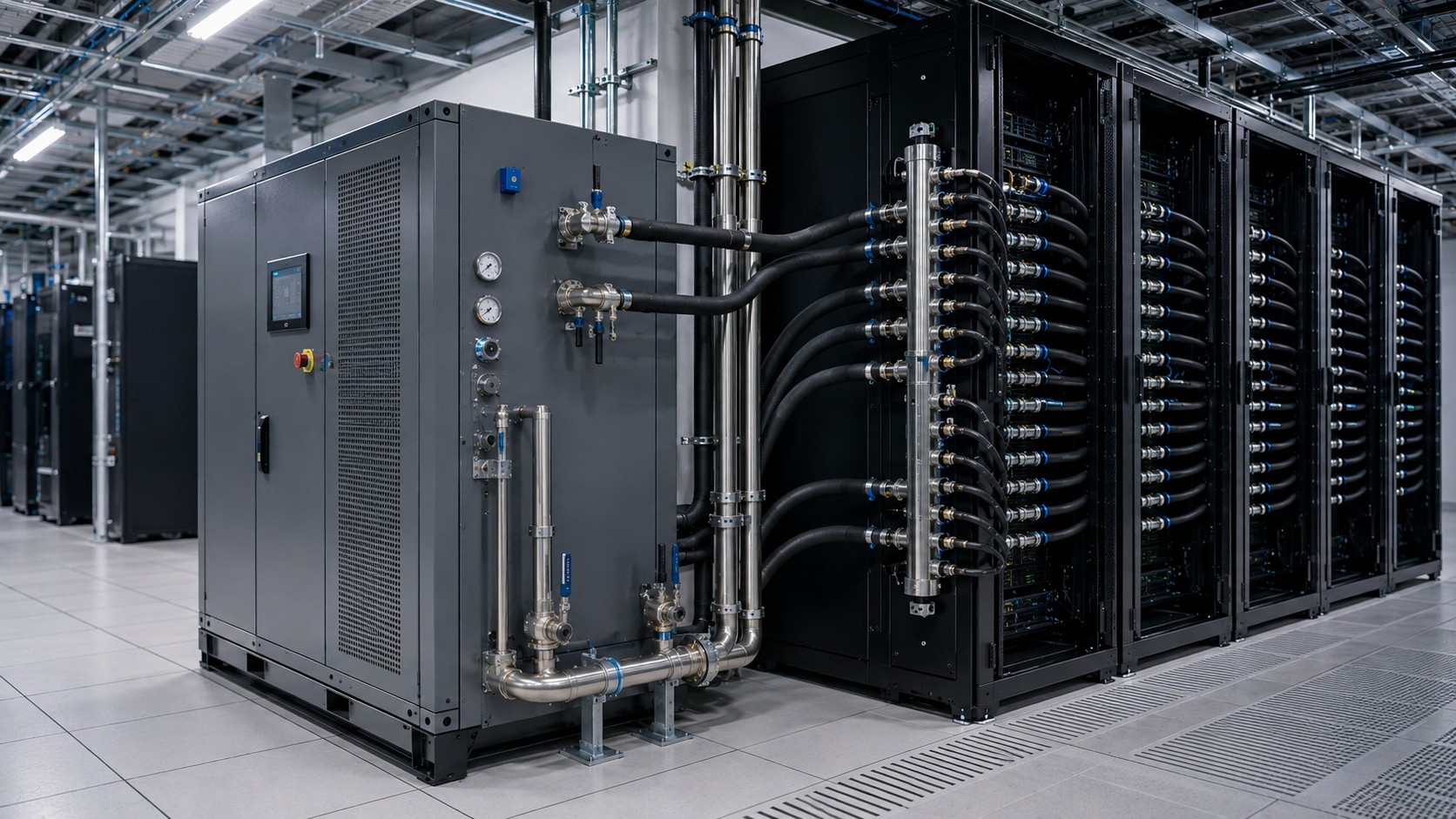
If you are planning direct liquid cooling for high-density servers, the coolant distribution unit is one of the pieces of infrastructure you need to understand.
So, what is a coolant distribution unit?
A coolant distribution unit, usually shortened to CDU, manages coolant circulation between liquid-cooled IT equipment and the wider data centre cooling infrastructure. In a liquid-to-liquid system, it also transfers heat between two separate cooling loops so that facility water does not circulate directly through sensitive server cooling components.
CDUs are particularly important in direct-to-chip systems, where coolant flows through cold plates mounted on CPUs, GPUs and other high-power components.
A liquid-to-liquid CDU is therefore much more than a pump. It combines heat transfer, coolant circulation, and control functions within the cooling architecture.
Where does a CDU sit in a liquid-cooling system?
The simplest way to understand the CDU's role is to trace how heat leaves the processor.
In a typical direct-to-chip installation, a processor generates heat while operating. A cold plate mounted directly against the component transfers that heat into a circulating coolant.
The warmed coolant then travels through the rack or row distribution system towards the CDU. Inside the CDU, heat is transferred towards the facility cooling system before the technology-side coolant is circulated back towards the servers.
In simplified form:
CPU or GPU → cold plate → manifold → CDU → facility cooling system
The cooled fluid then returns through the technology cooling loop.
Our guide to liquid cooling for data centres explains how this arrangement fits alongside other air and liquid-cooling approaches.
Many CDU-based systems separate the liquid circulating through the IT equipment from the water serving the wider facility.
ASHRAE refers to these as the technology cooling system (TCS) and facility water system (FWS) .
The latest ASHRAE requirements for liquid-to-liquid CDUs define a CDU as an assembly that separates the TCS coolant from the FWS or another intermediate heat-rejection loop while transferring thermal energy between them.
That separation allows each side to be managed around its own requirements for:
fluid chemistry
cleanliness
temperature
operating pressure
flow rate
wetted-material compatibility
The heat moves between the systems through a heat exchanger, while the two fluids remain separate.
What does the CDU actually control?

A CDU can perform several functions at the same time.
The exact specification varies between CDU designs.
"CDU" describes a function within the liquid-cooling architecture rather than one standard unit with a fixed capacity or configuration.
The Open Compute Project CDU Sub-Project focuses specifically on coolant distribution and the integration of liquid-cooling infrastructure into new and existing data centres.
Rack, row, or facility level?
CDU placement depends on the scale and hydraulic design of the liquid-cooling system.
A rack CDU serves equipment within or immediately around an individual rack.
This can suit more contained deployments where coolant distribution is kept close to the servers, although the CDU may also occupy space that could otherwise be used for IT hardware.
A larger CDU can serve several racks through distribution manifolds.
This centralises functions such as pumping, monitoring and heat transfer while supporting multiple liquid-cooled racks from a shared system.
At greater scale, data centres can use central cooling and distribution infrastructure serving multiple rows or cooling zones.
The choice is not simply a question of maximum cooling capacity.
Pipe runs, pressure drop, redundancy, maintenance access, available space and future expansion all influence which arrangement is appropriate.
What determines the right CDU size?
Thermal capacity matters, but it does not determine CDU suitability on its own.
A workable design needs to consider the thermal and hydraulic characteristics of the complete cooling loop.
CDU capacity should be based on the design thermal load of the connected equipment, with appropriate allowance for operating conditions, resilience, and future expansion rather than rack rating alone.
A rack might have a high theoretical electrical capacity without continuously producing that level of heat, while future hardware generations may increase the load significantly.
The design therefore needs to account for both current requirements and the expected operating envelope.
Cold plates require sufficient flow to remove heat effectively.
A CDU supporting multiple high-power GPU servers may therefore need very different flow characteristics from one serving a smaller CPU deployment, even where their headline thermal capacities appear similar.
Coolant meets resistance as it moves through:
pipework
hoses
quick-disconnect fittings
manifolds
valves
cold plates
The pump arrangement needs to overcome that resistance while keeping individual components within their specified pressure limits.
Every wetted material in the cooling loop must be compatible with the chosen coolant.
That includes cold plates, pipes, connectors, seals, hoses, and other components.
Poor compatibility can contribute to corrosion, contamination, or deterioration over time.
The Open Compute Project's Cold Plate Cooling Loop Requirements treat the system between the CDU, rack manifold, and IT equipment as a connected cooling loop, reinforcing why these components need to be specified together rather than independently.
Supply temperature affects both component cooling and the wider facility design.
It also needs to be assessed against the dew point of the surrounding air. If pipework, connectors or other surfaces fall below the local dew point, condensation can become a risk.
A CDU is not a chiller or a manifold
Several components sit between a processor and the point where heat eventually leaves the facility, but their roles are different.
A CDU does not replace the whole cooling system.
Its job is to create and control the connection between liquid-cooled IT hardware and the facility infrastructure that ultimately removes the heat.
Why CDU design matters as rack density rises
At lower densities, conventional airflow may be able to remove the required heat effectively.
As GPU rack density increases, significantly more heat has to be removed from the same physical footprint.
Direct-to-chip cooling responds by moving the heat-removal mechanism directly to the CPUs and GPUs producing the largest thermal load. Once that approach is used, coolant distribution becomes part of the resilience of the compute environment itself.
A CDU that cannot provide the necessary flow, pressure, or heat-transfer capacity can constrain the wider cooling loop even if the individual cold plates are correctly specified.
The cooling design should therefore begin with the hardware.
Processor configuration, expected power draw, rack density, cold-plate requirements and planned expansion all affect the CDU and distribution infrastructure required.
Planning CDU infrastructure for high-density workloads

For organisations adopting direct-to-chip cooling, the CDU should be considered as part of the complete coolant path rather than treated as an isolated piece of equipment.
In Carbon-Z's direct-to-chip cooling service , CDUs form part of a wider managed cooling environment that also includes coolant distribution, manifold installation, leak detection and scheduled maintenance.
That reflects an important practical point. CDU selection cannot be separated from the hardware, manifolds, pipework and facility cooling conditions around it.
Before the system is designed, you need to establish:
which CPUs and GPUs will be installed
expected rack power density
required coolant temperatures
cold-plate flow requirements
pressure drop across the complete loop
coolant compatibility
redundancy requirements
monitoring and leak-detection needs
maintenance access
likely future hardware changes
If those requirements are not yet clear, a Carbon-Z power assessment can help establish the workload's power and density requirements before you commit to the final rack and cooling design.
What should you know before specifying a CDU?
A CDU only works as well as the cooling system around it.
The unit needs to match the thermal demand of the hardware, but also the hydraulic behaviour of the complete loop, the available facility cooling conditions, and the resilience required by the workload.
That is why CDU selection should not begin with a product catalogue.
Begin with the compute environment and trace the heat path outwards.
Once you understand how much heat the hardware will generate, how the coolant needs to move, and where that heat will ultimately be rejected, the required CDU capacity, configuration, and controls become far easier to define.



%20--%3e%3csvg%20version='1.1'%20id='Layer_1'%20xmlns='http://www.w3.org/2000/svg'%20xmlns:xlink='http://www.w3.org/1999/xlink'%20x='0px'%20y='0px'%20viewBox='0%200%20388.2%20150.6'%20style='enable-background:new%200%200%20388.2%20150.6;'%20xml:space='preserve'%3e%3cstyle%20type='text/css'%3e%20.st0{fill:%2304C7FD;}%20.st1{fill:%230068B5;}%20%3c/style%3e%3crect%20y='2.1'%20class='st0'%20width='28.1'%20height='28.1'/%3e%3cpath%20class='st1'%20d='M27.4,148.5V47.3H0.8v101.2H27.4z%20M204.2,149.5v-24.8c-3.9,0-7.2-0.2-9.6-0.6c-2.8-0.4-4.9-1.4-6.3-2.8%20c-1.4-1.4-2.3-3.4-2.8-6c-0.4-2.5-0.6-5.8-0.6-9.8V70.1h19.3V47.3h-19.3V7.8h-26.7v97.9c0,8.3,0.7,15.3,2.1,20.9%20c1.4,5.5,3.8,10,7.1,13.4s7.7,5.8,13,7.3c5.4,1.5,12.2,2.2,20.3,2.2L204.2,149.5L204.2,149.5z%20M357,148.5V0h-26.7v148.5H357z%20M132.5,57.2c-7.4-8-17.8-12-31-12c-6.4,0-12.2,1.3-17.5,3.9c-5.2,2.6-9.7,6.2-13.2,10.8l-1.5,1.9v-1.7V47.3H43v101.2h26.5V94.6v3.7%20c0-0.6,0-1.2,0-1.8c0.3-9.5,2.6-16.5,7-21c4.7-4.8,10.4-7.2,16.9-7.2c7.7,0,13.6,2.4,17.5,7c3.8,4.6,5.8,11.1,5.8,19.4l0,0v0.2l0,0%20l0,0v53.5h26.9V91C143.7,76.6,139.9,65.2,132.5,57.2z%20M316.5,97.7c0-7.3-1.3-14.1-3.8-20.5c-2.6-6.3-6.2-11.9-10.7-16.7%20c-4.6-4.8-10.1-8.5-16.5-11.2s-13.5-4-21.2-4c-7.3,0-14.2,1.4-20.6,4.1c-6.4,2.8-12,6.5-16.7,11.2s-8.5,10.3-11.2,16.7%20c-2.8,6.4-4.1,13.3-4.1,20.6c0,7.3,1.3,14.2,3.9,20.6c2.6,6.4,6.3,12,10.9,16.7c4.6,4.7,10.3,8.5,16.9,11.2%20c6.6,2.8,13.9,4.2,21.7,4.2c22.6,0,36.6-10.3,45-19.9l-19.2-14.6c-4,4.8-13.6,11.3-25.6,11.3c-7.5,0-13.7-1.7-18.4-5.2%20c-4.7-3.4-7.9-8.2-9.6-14.1l-0.3-0.9h79.5L316.5,97.7L316.5,97.7z%20M237.2,88.4c0-7.4,8.5-20.3,26.8-20.4c18.3,0,26.9,12.9,26.9,20.3%20L237.2,88.4z'/%3e%3cpath%20class='st1'%20d='M387.4,135.3c-0.5-1.2-1.2-2.2-2.1-3.1c-0.9-0.9-1.9-1.6-3.1-2.1s-2.5-0.8-3.8-0.8c-1.4,0-2.6,0.3-3.8,0.8%20c-1.2,0.5-2.2,1.2-3.1,2.1c-0.9,0.9-1.6,1.9-2.1,3.1c-0.5,1.2-0.8,2.5-0.8,3.8c0,1.4,0.3,2.6,0.8,3.8s1.2,2.2,2.1,3.1%20c0.9,0.9,1.9,1.6,3.1,2.1s2.5,0.8,3.8,0.8c1.4,0,2.6-0.3,3.8-0.8c1.2-0.5,2.2-1.2,3.1-2.1c0.9-0.9,1.6-1.9,2.1-3.1%20c0.5-1.2,0.8-2.5,0.8-3.8S387.9,136.5,387.4,135.3z%20M385.8,142.3c-0.4,1-1,1.9-1.7,2.6c-0.7,0.7-1.6,1.3-2.6,1.7s-2,0.6-3.2,0.6%20c-1.1,0-2.2-0.2-3.2-0.6c-1-0.4-1.9-1-2.6-1.7s-1.3-1.6-1.7-2.6c-0.4-1-0.6-2-0.6-3.2c0-1.1,0.2-2.2,0.6-3.2s1-1.9,1.7-2.6%20c0.7-0.7,1.6-1.3,2.6-1.7s2-0.6,3.2-0.6c1.1,0,2.2,0.2,3.2,0.6c1,0.4,1.9,1,2.6,1.7s1.3,1.6,1.7,2.6c0.4,1,0.6,2,0.6,3.2%20C386.5,140.3,386.2,141.3,385.8,142.3z%20M380.2,139.9c0.8-0.1,1.4-0.4,1.9-0.9s0.8-1.2,0.8-2.2c0-1.1-0.3-1.9-1-2.5%20c-0.6-0.6-1.7-0.9-3-0.9h-4.4v11.3h2.1v-4.6h1.5l2.8,4.6h2.2L380.2,139.9z%20M379.1,138.3c-0.3,0-0.6,0-1,0h-1.5v-3.2h1.5%20c0.3,0,0.6,0,1,0c0.3,0,0.6,0.1,0.9,0.2c0.3,0.1,0.5,0.3,0.6,0.5s0.2,0.5,0.2,0.9s-0.1,0.7-0.2,0.9c-0.2,0.2-0.4,0.4-0.6,0.5%20C379.7,138.2,379.4,138.3,379.1,138.3z'/%3e%3c/svg%3e)