
Water is the quiet variable in the data centre sustainability conversation. Power gets the headlines, because electricity is where the big numbers sit and where regulators have the clearest tools. Water consumption has been treated as a background cost for years, until drought, population pressure and the sheer scale of AI build-out dragged it into the open.
The gap between how US and UK facilities use water is bigger than most sustainability reports suggest, and it is almost entirely a climate story, cooling architecture and the decisions those two forces have forced operators into. This piece sets out the real differences, where the numbers land, and the point at which the question stops being about water at all.
Why water is suddenly on the agenda
Data centres are not the largest water users in either country. Agriculture dwarfs them, so does domestic consumption. What makes data centre water use politically sensitive is three things: the facilities are concentrated in a small number of sites, those sites tend to grow fast rather than at a predictable pace, and the water they consume is almost always clean, treated drinking water drawn from the same supply as the surrounding population.
According to the IEA’s Energy and AI analysis, global data centre water withdrawal is expected to grow materially through the rest of the decade, driven by AI workloads that run hotter and denser than the enterprise applications they are replacing. That growth lands very differently on the UK and US depending on where the facilities are built and how they are cooled.
The climate dictates the architecture
A data centre needs to reject heat somewhere. Water is a far more efficient heat-transfer medium than air, which is why hot and arid regions have historically relied on evaporative cooling: pulling water through a cooling tower, letting it evaporate, and using the phase change to carry heat away. It is cheap, it is simple, and it works brilliantly in dry climates where the ambient air can absorb the moisture.
The UK does not have that climate. Average annual temperatures in the main data centre corridors (Thames Valley, M4, North West) sit around 10 to 11°C, humidity is high, and the number of hours per year where free cooling is viable is substantial. UK operators can run dry coolers and closed-loop chilled water systems for the majority of their operating hours and only lean on evaporative or adiabatic assistance during the warmest weeks. The water consumption consequence is enormous: a UK site can run for most of the year without consuming meaningful volumes of potable water at all.
The US picture is more varied. Northern states can run similar architectures. The problem is that the hyperscale footprint sits disproportionately in Virginia, Texas, Arizona, Nevada and Oregon, where ambient conditions make evaporative cooling the only economically viable choice at scale. Uptime Institute’s global surveys consistently show the US average water usage effectiveness (WUE) running significantly higher than the European average, with hot-climate sites measured at several litres of water per kilowatt-hour of IT load.
Where the numbers land
The table below gives the comparison in the shape operators actually care about: cooling architecture, climate fit, water impact, and the kind of site where each one sits.
| Factor | US typical (hot-climate sites) | UK typical | Water consequence |
|---|---|---|---|
| Dominant cooling architecture | Evaporative cooling towers with chilled water assist | Dry coolers or closed-loop chilled water with free cooling | US sites consume 1.5 to 4+ L/kWh; UK sites often below 0.5 L/kWh |
| Free cooling hours per year | Low to moderate (depending on state) | High across most of the UK | UK runs mechanical cooling only in summer; US runs it continuously |
| Water source | Municipal potable supply, groundwater in some states | Mains supply, limited abstraction licences | US competes directly with drinking water in drought regions |
| Regulatory oversight | State and local permits, varying transparency | Environment Agency, Ofwat scrutiny, abstraction licensing | UK operators face tighter disclosure obligations |
| New-build direction | Air cooling plus adiabatic, with liquid cooling for AI | Direct-to-chip and immersion gaining traction | Liquid cooling eliminates most IT-side water consumption |
Two notes on the figures. The US “typical” row is deliberately drawn from hot-climate hyperscale sites because that is where the public concern sits. US sites in cooler northern states look much closer to UK numbers. And the UK average pulls down because of climate advantage, not necessarily because operators are making systematically better choices.
The UK is not immune
The UK’s climate advantage can read like a free pass. It is not.
The Thames Valley sits in one of the most water-stressed regions in England. The south east has lower rainfall than much of the rest of the country, higher population density, and a water infrastructure that is already under strain. A UK Parliament research briefing on data centres notes that the sector’s water use is small relative to agricultural and domestic demand but concentrated in exactly the regions where supply is tightest. Ofwat and the Environment Agency have both begun to look at data centre water abstraction more seriously, and new planning applications now routinely include water-stress assessments.
In other words: the UK does not have the Phoenix problem, but the Slough and West London corridor is drifting towards a smaller version of it. The response is not more evaporative cooling. It is a quieter architectural shift that is already underway.
Where liquid cooling changes the question
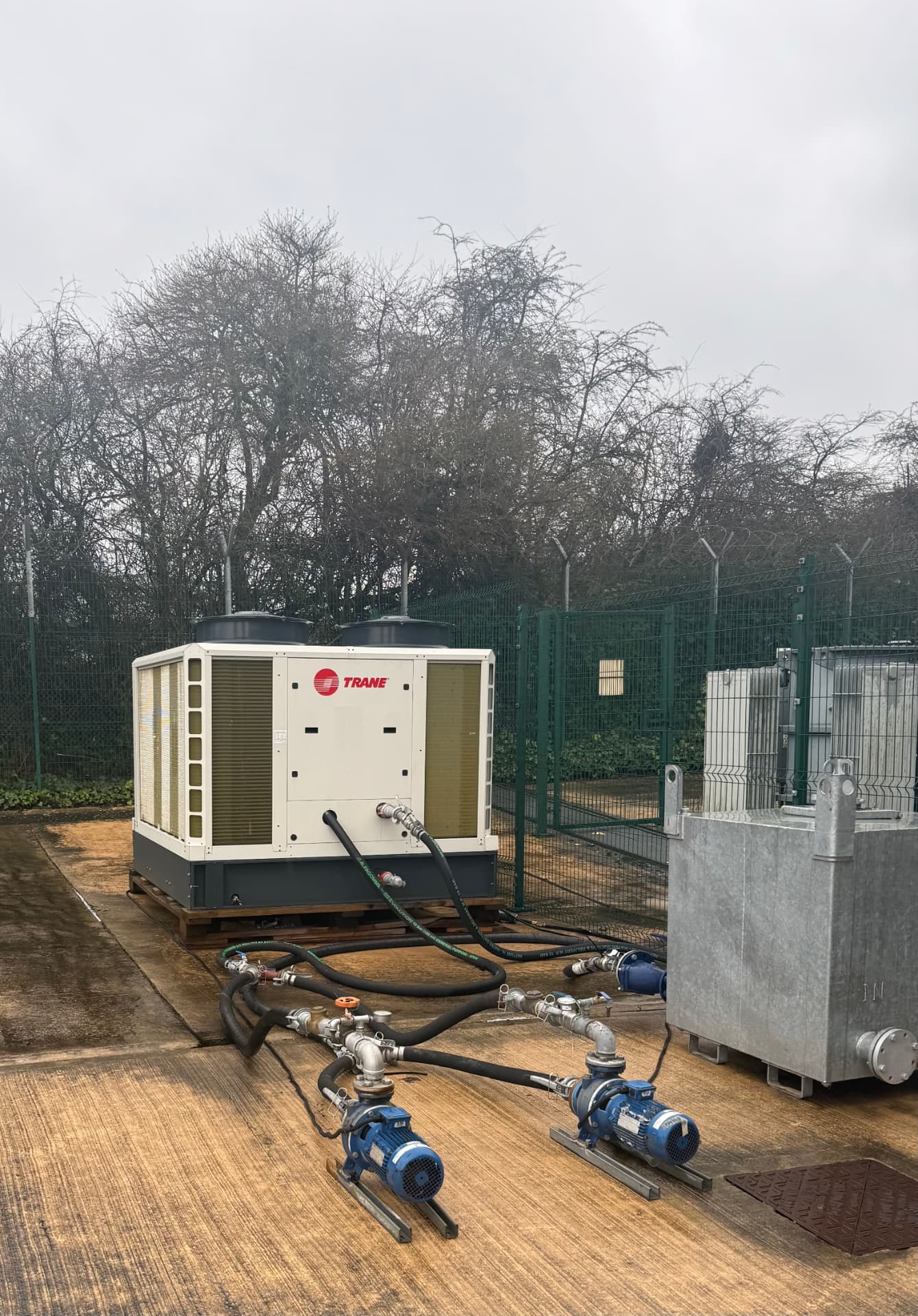
The water conversation changes shape when the cooling moves inside the rack. A direct-to-chip loop uses dielectric fluid or treated water in a sealed, closed system that neither consumes nor evaporates. Immersion cooling goes further again, submerging the hardware in dielectric fluid that transfers heat into a heat exchanger with no interaction with the municipal water supply at all. Both approaches shift the heat-rejection problem to the facility level, where dry coolers can handle it in a UK climate without any meaningful water draw.
For AI and HPC workloads where rack densities exceed 60kW, this is not a sustainability preference. It is an engineering necessity: air cooling cannot remove enough heat per rack, and evaporative-tower retrofits in UK sites hit a water-stress wall long before they hit a thermal limit. Direct-to-chip cooling and immersion are what the architecture is moving towards regardless of the water question. The water advantage is a side effect.
We operate AI-ready data centres across the UK built around closed-loop liquid cooling as the default rather than the exception. The climate advantage of running compute in Britain is real. The way to keep it real as densities climb is to stop relying on evaporative water for cooling at all.
Frequently asked questions
How much water does a typical UK data centre use compared to a US one?
Water Usage Effectiveness (WUE) is the standard metric, expressed as litres of water per kilowatt-hour of IT load. UK sites typically sit below 0.5 L/kWh and well-designed sites run much lower, because the climate allows dry cooling for the majority of the year. US hyperscale sites in hot climates often sit between 1.5 and 4 L/kWh, with some reporting higher. The gap is driven almost entirely by cooling architecture dictated by local climate, not by operator choice.
Is water a bigger sustainability issue than power for data centres?
Not globally, but locally it can be. Power dominates the carbon footprint and the grid conversation. Water becomes the pressing issue where facilities concentrate in water-stressed regions, which is why Phoenix and Northern Virginia have become political flashpoints in the US and why Slough and West London are starting to see similar scrutiny in the UK. For a sustainability report, both metrics matter. For a planning application in the south east of England, water is often the harder question.
Does liquid cooling actually eliminate water consumption?
Yes on the IT side, mostly. Direct-to-chip and immersion systems use closed-loop fluid that is not consumed in operation. The heat still needs to leave the facility, which usually means dry coolers or, in warmer conditions, an adiabatic assist. In a UK climate, the facility-level water draw of a liquid-cooled site is a fraction of an equivalent evaporative-cooled site, and in many designs it approaches zero. The sustainability case is strong. The engineering case for AI densities is stronger.



%20--%3e%3csvg%20version='1.1'%20id='Layer_1'%20xmlns='http://www.w3.org/2000/svg'%20xmlns:xlink='http://www.w3.org/1999/xlink'%20x='0px'%20y='0px'%20viewBox='0%200%20388.2%20150.6'%20style='enable-background:new%200%200%20388.2%20150.6;'%20xml:space='preserve'%3e%3cstyle%20type='text/css'%3e%20.st0{fill:%2304C7FD;}%20.st1{fill:%230068B5;}%20%3c/style%3e%3crect%20y='2.1'%20class='st0'%20width='28.1'%20height='28.1'/%3e%3cpath%20class='st1'%20d='M27.4,148.5V47.3H0.8v101.2H27.4z%20M204.2,149.5v-24.8c-3.9,0-7.2-0.2-9.6-0.6c-2.8-0.4-4.9-1.4-6.3-2.8%20c-1.4-1.4-2.3-3.4-2.8-6c-0.4-2.5-0.6-5.8-0.6-9.8V70.1h19.3V47.3h-19.3V7.8h-26.7v97.9c0,8.3,0.7,15.3,2.1,20.9%20c1.4,5.5,3.8,10,7.1,13.4s7.7,5.8,13,7.3c5.4,1.5,12.2,2.2,20.3,2.2L204.2,149.5L204.2,149.5z%20M357,148.5V0h-26.7v148.5H357z%20M132.5,57.2c-7.4-8-17.8-12-31-12c-6.4,0-12.2,1.3-17.5,3.9c-5.2,2.6-9.7,6.2-13.2,10.8l-1.5,1.9v-1.7V47.3H43v101.2h26.5V94.6v3.7%20c0-0.6,0-1.2,0-1.8c0.3-9.5,2.6-16.5,7-21c4.7-4.8,10.4-7.2,16.9-7.2c7.7,0,13.6,2.4,17.5,7c3.8,4.6,5.8,11.1,5.8,19.4l0,0v0.2l0,0%20l0,0v53.5h26.9V91C143.7,76.6,139.9,65.2,132.5,57.2z%20M316.5,97.7c0-7.3-1.3-14.1-3.8-20.5c-2.6-6.3-6.2-11.9-10.7-16.7%20c-4.6-4.8-10.1-8.5-16.5-11.2s-13.5-4-21.2-4c-7.3,0-14.2,1.4-20.6,4.1c-6.4,2.8-12,6.5-16.7,11.2s-8.5,10.3-11.2,16.7%20c-2.8,6.4-4.1,13.3-4.1,20.6c0,7.3,1.3,14.2,3.9,20.6c2.6,6.4,6.3,12,10.9,16.7c4.6,4.7,10.3,8.5,16.9,11.2%20c6.6,2.8,13.9,4.2,21.7,4.2c22.6,0,36.6-10.3,45-19.9l-19.2-14.6c-4,4.8-13.6,11.3-25.6,11.3c-7.5,0-13.7-1.7-18.4-5.2%20c-4.7-3.4-7.9-8.2-9.6-14.1l-0.3-0.9h79.5L316.5,97.7L316.5,97.7z%20M237.2,88.4c0-7.4,8.5-20.3,26.8-20.4c18.3,0,26.9,12.9,26.9,20.3%20L237.2,88.4z'/%3e%3cpath%20class='st1'%20d='M387.4,135.3c-0.5-1.2-1.2-2.2-2.1-3.1c-0.9-0.9-1.9-1.6-3.1-2.1s-2.5-0.8-3.8-0.8c-1.4,0-2.6,0.3-3.8,0.8%20c-1.2,0.5-2.2,1.2-3.1,2.1c-0.9,0.9-1.6,1.9-2.1,3.1c-0.5,1.2-0.8,2.5-0.8,3.8c0,1.4,0.3,2.6,0.8,3.8s1.2,2.2,2.1,3.1%20c0.9,0.9,1.9,1.6,3.1,2.1s2.5,0.8,3.8,0.8c1.4,0,2.6-0.3,3.8-0.8c1.2-0.5,2.2-1.2,3.1-2.1c0.9-0.9,1.6-1.9,2.1-3.1%20c0.5-1.2,0.8-2.5,0.8-3.8S387.9,136.5,387.4,135.3z%20M385.8,142.3c-0.4,1-1,1.9-1.7,2.6c-0.7,0.7-1.6,1.3-2.6,1.7s-2,0.6-3.2,0.6%20c-1.1,0-2.2-0.2-3.2-0.6c-1-0.4-1.9-1-2.6-1.7s-1.3-1.6-1.7-2.6c-0.4-1-0.6-2-0.6-3.2c0-1.1,0.2-2.2,0.6-3.2s1-1.9,1.7-2.6%20c0.7-0.7,1.6-1.3,2.6-1.7s2-0.6,3.2-0.6c1.1,0,2.2,0.2,3.2,0.6c1,0.4,1.9,1,2.6,1.7s1.3,1.6,1.7,2.6c0.4,1,0.6,2,0.6,3.2%20C386.5,140.3,386.2,141.3,385.8,142.3z%20M380.2,139.9c0.8-0.1,1.4-0.4,1.9-0.9s0.8-1.2,0.8-2.2c0-1.1-0.3-1.9-1-2.5%20c-0.6-0.6-1.7-0.9-3-0.9h-4.4v11.3h2.1v-4.6h1.5l2.8,4.6h2.2L380.2,139.9z%20M379.1,138.3c-0.3,0-0.6,0-1,0h-1.5v-3.2h1.5%20c0.3,0,0.6,0,1,0c0.3,0,0.6,0.1,0.9,0.2c0.3,0.1,0.5,0.3,0.6,0.5s0.2,0.5,0.2,0.9s-0.1,0.7-0.2,0.9c-0.2,0.2-0.4,0.4-0.6,0.5%20C379.7,138.2,379.4,138.3,379.1,138.3z'/%3e%3c/svg%3e)